

The Complete Guide to Hosting Mahjong Night
The truth? We’ve watched a lot of mahjong nights — or mah jongg nights, if you’re feeling vintage about it. Fine ones, and legendary ones: the kind where nobody checks their phone by hour two, and the kind where someone fakes a headache at nine-thirty. The kind where the hostess glows, and the kind where she is visibly counting down to bedtime.
We’ve hosted in city apartments and country houses, at kitchen tables and dining tables, with beginners and with women who could play blindfolded (always with snacks, obviously). The difference was never the cheese board budget, or the vintage, or the monogrammed napkins, or whether the playlist skewed Billie Holiday or Beyoncé.
It was a handful of small, deliberate decisions — tiny, almost invisible choices that compound into an evening people talk about for months. Here they all are.
The table is the party
Everything else is just conversation, and we mean that literally. A mahjong table is not a card table with homework spread across it; it is the room’s gravitational center, the place where your guests’ eyes land the moment they walk in. They find the mat, the racks, and the small, irresistible promise of an evening that asks nothing of them except presence.
Most card tables do the job beautifully — ours are thirty-one and a half inches square, a perfect fit. Four players, four walls, no elbows in ribs, and enough room for the small rituals that make a night feel intentional.
The question is what lives on top. The mat, bare against walnut or oak, reads as editorial and spare; a tablecloth underneath (ours are in the collection right here) adds layers, texture, that Nancy Meyers moment where the room feels lived-in before anyone sits down.
Layering is a language, and both choices are correct. (We have strong opinions about both, and we exercise them regularly.) The wrong choice is worrying about it too much.

But here is the honest confession. By hour two, someone will knock over a negroni; by hour three, olive oil from the bread bowl has performed a small escape, and a rogue dot of hummus will have colonized the corner. This is not a flaw — this is hospitality, because mess is simply the proof that people relaxed (and a small argument for dark-colored tablecloths, if we’re being honest).
Which is exactly why we print on PLAYFINISH™ — waterproof, wipeable, sound-dampening, the host’s quiet insurance policy in a wildly chic package. The Caned Trompe L’oeil Natural mat handles it all: red wine, olive oil, the occasional tear of joy. It performs beautifully. It simply happens to be beautiful.
Seats, light, and the sound of tiles
Four chairs, three hours, choose accordingly. The best seat is the one you forget you’re sitting in: no arms that fight the rack, no depth that swallows you like a library sofa, and no wheels, because no one needs to travel mid-hand. Just a straightforward chair that lets you reach the wall without a pilgrimage.

Light is less romantic than you think. Overhead wins every time — you’re reading a card, not a novel, and small type at ten p.m. is no match for a single moody lamp in the corner.
We learned the hard way, squinting at a Flower tile under a forty-watt Edison bulb, wondering if our eyes were older than we admitted. (Forty is the new squint, apparently.) The solution is a simple flush-mount fixture with a dimmer, or a pendant that pools light exactly where the tiles live.

And then there is the sound. Tiles on wood are pretty for exactly five minutes, and then they are loud — the click-clack symphony that charms at first becomes percussion by hour three, and the person in the next room is developing a detailed theory about your gatherings.
PLAYFINISH™ was designed with this in mind: sound-dampening is a hosting kindness your neighbors will never know to thank you for.
Food that survives the table
The one-hand rule: nothing that drips, nothing that dusts, nothing that requires a fork, a knife, or a prayer. Cheeto fingers on white tiles is a horror story told in one sentence, and the orange dust does not respect boundaries.
Boards before the first Charleston — a generous one. Cheese, charcuterie, olives, bread: the kind of spread that says “we’re settling in” without saying a word. Then sweets after the last hand, chocolate that doesn’t crumble, berries that don’t stain, and macarons, if you’re feeling whimsical.
We keep a small bowl of lemon wedges nearby. Not for the drinks. For the fingers. Citrus is the original wet wipe, and it smells better than regret.


This is a mahjong mat, not a placemat — we would still rather you ate dinner somewhere else. But an accident is not a crisis. A little wine, a stray drop of soy sauce, a thumbprint of something greasy: ours wipe clean and carry on, which is rather the point of printing on something waterproof in the first place. Put the glass down. Snap trays live in the dining collection for corralling dice and spare tiles between hands, and they keep the surface editorial rather than chaotic.
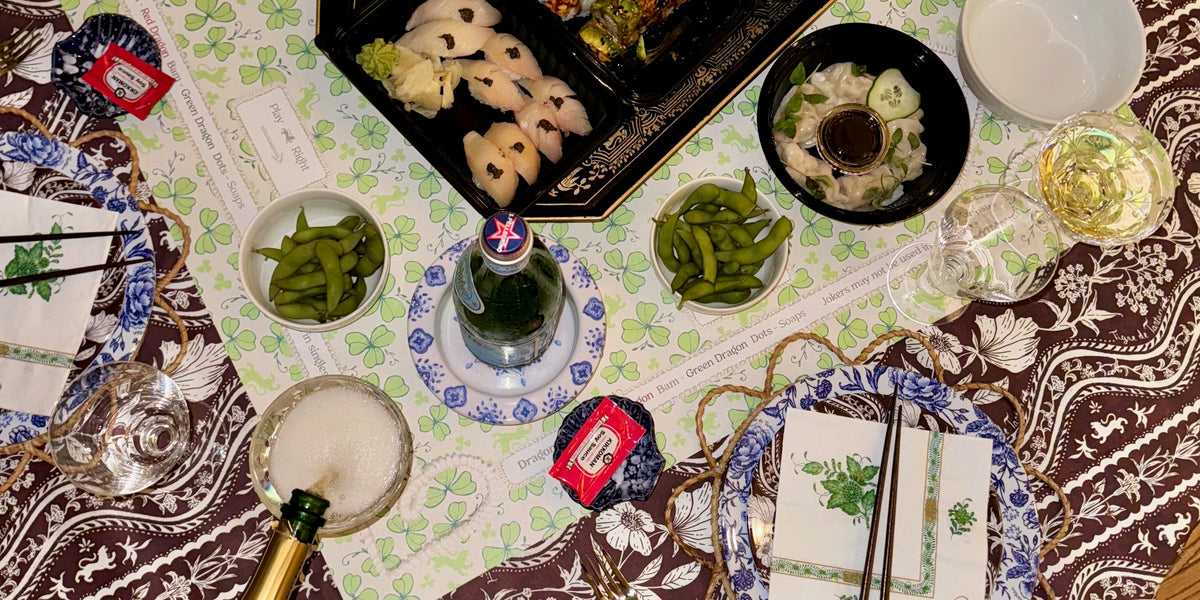
The Tiger Heart cocktail napkins were basically invented for this moment (they weren’t, but they should have been), and the Chinoiserie Bleu plates, eight inches of hand-illustrated charm, make even grocery-store cheese look curated. The real secret? Nothing on the mat mid-hand except the game. The best host is the one who isn’t hovering.
The rhythm of the night
Arrival drinks are a trap. Thirty minutes, max, then tiles — because after that people settle into conversational grooves that are hard to interrupt, and the evening shifts from “game night” to “dinner party that happens to have tiles.”
The Charleston is the actual icebreaker: better than any forced introduction, more effective than a name tag, more democratic than a seating chart. By the time the first hand begins, everyone has spoken to everyone. That is not an accident — it is architecture, and it is the reason mahjong has survived centuries.
How many hands fit in an evening? Fewer than you think. Four, maybe five if the group knows the rhythm and nobody needs a rules refresher. The best nights leave people wanting one more, not wishing the last one would hurry up and die.
For mixed-skill tables — and most are, because half the joy is converting the curious — seat the newest player across from the calmest one. Not next to. Across. Eye contact is a tutorial, and patience is contagious. If someone needs a refresher, send them our How to Play guide ahead of time; it lands better in daylight than at the table.
The break matters, and not a scheduled one. A natural one — when the energy dips, when the snacks need refreshing, when someone needs to step outside and call home. Let it happen; the game will wait. The tiles have been waiting for a hundred years, and they can handle ten minutes. The pause is where the best stories happen.
And here is the part we mean sincerely. Mahjong is a reason to slow down and be fully present with the people who matter most. The tiles are just the excuse, and the friendship is the event. The table is the altar, and the gathering is the prayer.
We know that sounds wildly sentimental. We don’t care — it’s true. Female friendship deserves a ritual this deliberate. This joyful. This unhurried.
The tiles are just the excuse, and the friendship is the event.
Tigre de TartánThe details they’ll text about tomorrow
Small generosities over grand gestures. Every time. Place cards on the racks — not because anyone needs assigned seating, but because handwriting on cardstock feels like a dinner party from another era. A lost art, and the kind of touch that makes people feel chosen, not just invited.
A themed drink named for the game — the Charleston Spritz, the Lucky Joker, the Sweet Pass — turns a Tuesday into an occasion. It doesn’t need to be mixology; it simply needs to be named.
We knew a host who served her grandmother’s crystal highballs filled with nothing fancier than sparkling water and a twist, and the glasses did the work. Elevation is sometimes just a vessel.

We once saw a host gift the evening’s winner a needle minder from our shop. The recipient still talks about it, still uses it, still tells the story of the hand she won and the tiny charm that came with it. The favor is the punctuation mark at the end of the evening’s sentence (period, not exclamation point — we’re understated).


These are the details that turn a game night into a memory. They cost almost nothing, and they return endlessly. They are the reason your group text lights up the next morning.
The five-minute reset
Cleanup is a design feature, not a chore. Wipe the mat, tiles in the bag, done. The point isn’t tidiness — the point is that easy cleanup is why there is a next mahjong night.
When the reset takes five minutes, you will say yes to the impromptu Thursday, and you will host on a school night, because the barrier to entry is almost nothing.
Our Mahjong Field Bag was built for exactly this — everything in one place, nothing to hunt for, no excuse not to schedule the sequel. It is heirloom organization disguised as a simple canvas bag (and yes, it fits under an airplane seat — we checked).

The secret? Nobody remembers the food. They remember who they sat across from, the laugh that turned into a cough, the tile they drew that changed everything, and the hand that went wrong in the best possible way. The moment someone looked up and said, “We should do this every week.”
Set a beautiful table anyway.