

Choosing a Mat
The short answer
- 31.5 inches square. It fits a card table with a handsome margin, and every other measurement on the table answers to it.
- Material decides sound, spills and how the thing photographs. Wool stains, neoprene reads as equipment, faux leather wipes clean and holds print.
- Thin and dense beats thick and soft. Sound-dampening is not about padding, and a spongy mat swallows the pushers along with the noise.
- Buy the one you would leave out on the table. A mat spends more hours gameless than in play.
Most people buy their first mahjong mat in five minutes. It arrives in a kit, or it's whatever the host already owned, or it's the first thing that could ship in two days. It lies flat enough, the tiles land on it, it works.
Then you play a few nights on it and start noticing things — the rack that overhangs the border seam, the corner that refuses to lie flat, the surface that looked wonderful online and reads, on your actual table, as equipment.
The second mat is the careful one.
By then you have opinions, even if you can't quite name them, and the naming is the useful part. Most mats disappoint on exactly one criterion — the size is right but the sound is wrong, the sound is right but the surface is blank — and the whole art of buying well is knowing which criteria exist.
This guide exists to skip you to the second purchase. Below: size, material, sound, and the question no spec sheet asks — what the mat looks like when nobody is playing. The criteria are real and the order matters. And yes, we make mats, so we have a stake in this argument; we'll state our case plainly and let the trade-offs do the talking.
Size: the 31.5-inch answer
Start with the square. For the American game — four racks, a wall built in the middle, discards in between — the working answer is about 31.5 inches, or 80cm, per side.
31.5″
Standard square
80 cm
The same number, metric
39″
Round mat, round table
19
Tiles in a wall
It's what a standard card table holds with a small, handsome margin, and it gives each player room for a rack, a row of discards, and the small choreography of reaching, drawing, and placing that an evening of mahj is made of. It also keeps the far wall reachable from every seat.

Go smaller and the failure is physical: racks ride the edge, tiles crowd, the wall shrinks to a suggestion. Go larger and the failure is social — the far tiles drift out of reach, and somebody stands up every third turn to fetch one. (We have watched this happen. It is never the graceful player who has to stand.)
Round mats exist, and on a round table they're the right answer: the wall sits naturally at the center and every player gets an equal arc. A 39-inch round, like our Nantucket Basket rules edition, is the one we'd point to first. On a square or card table, though, a round wastes the corners, and corners are where the discards live.
But the square is the standard. Thirty-one and a half inches. If you take one number from this guide, take that one.
Material: the real decision
Size is a measurement. Material is a philosophy.
Three materials do nearly all the work in this category, and we've written the long reference already: The Dictionary of Mahjong Mats. Here is the short one. Ask three questions of any material: what does it do to sound, what does it do to spills, and what does it look like while doing both?
Wool and felt. The heritage choice, and it deserves the title. A good wool mat is warm under the hand, hushes the tiles naturally, and carries a warmth synthetics rarely imitate — it is the surface of club rooms and inherited game tables, and it behaves like it. The trade-offs are honest ones: it stains, it stretches, it asks for a careful life. If your mat will live one, wool is a lovely answer.
Neoprene. Soft, flat-lying, dependable. It performs well; it simply speaks a different visual language. The surface absorbs light rather than holding it, and on a table set with linen and good glassware it reads as equipment. Which is fine, if equipment is the look you're after.
Faux leather. Leatherette, PU — the names change; the structure does not. It's wipeable, waterproof, and holds printed detail the way paper holds ink, which means the surface can carry real artwork instead of a texture pretending to be one. This is the house choice, and we won't pretend otherwise: every Tigre de Tartán mat is built on printed faux leather, for the reasons set out in the dictionary.
Wool / felt |
Neoprene |
Faux leather |
|
|---|---|---|---|
| Sound | Naturally soft | Soft, slightly hollow | Dampened, low and even |
| Spill survival | Stains | Wipes clean | Wipes clean, waterproof |
| Print clarity | Muted, matte | Soft focus | Sharp, saturated |
| Table feel | Warm, fibrous | Spongy | Smooth, structured |
| Aging | Stretches, pills | Curls at the edges | Holds its shape |
None of these will ruin a game. One of them will match your room.
Sound: the criterion nobody lists
A tile meets the mat a few thousand times in a night of American mah jongg — or mahjong, or mah-jongg, depending on which table you learned at. Multiply by four players, a long evening, and the small percussion of shuffling, stacking, and dealing, and the difference between clack and hush becomes the difference between a game room and a headache.
Sound-dampening is not about thickness. A thick, spongy mat quiets the tiles by swallowing them, and swallows everything else too: pushers drag instead of glide, racks sink at the corners, tiles wobble on a surface that behaves like a mattress. Thin but dense beats thick and soft, every time.
On a thin, dense surface the tile lands with a low, even note, the rack sits flat, the pusher glides — and the shuffle, that great wash of tiles turned face-down and mixed at the start of every game, goes from clatter to rustle.

This is, in the interest of disclosure, the argument behind PLAYFINISH™ — our finishing process, and ours are the only mats on the market made with it. Our claims for it are specific: waterproof, wipeable, sound-dampening. What we notice, playing on it, is simpler. You hear the game. You don't hear the table.
The test costs nothing. Deal one wall onto any mat you're considering and listen once, then imagine hearing it four hundred more times, over wine, on a Tuesday. The host notices this criterion first. The guests notice it second, without ever knowing why the evening felt calmer.
The surface when nobody's playing
Here is the question no spec sheet asks. A mat spends more hours out on the table than it spends being played on — days at a stretch, if the table is where the table is. So what should it look like at three in the afternoon, gameless, holding nothing but a bowl of lemons?

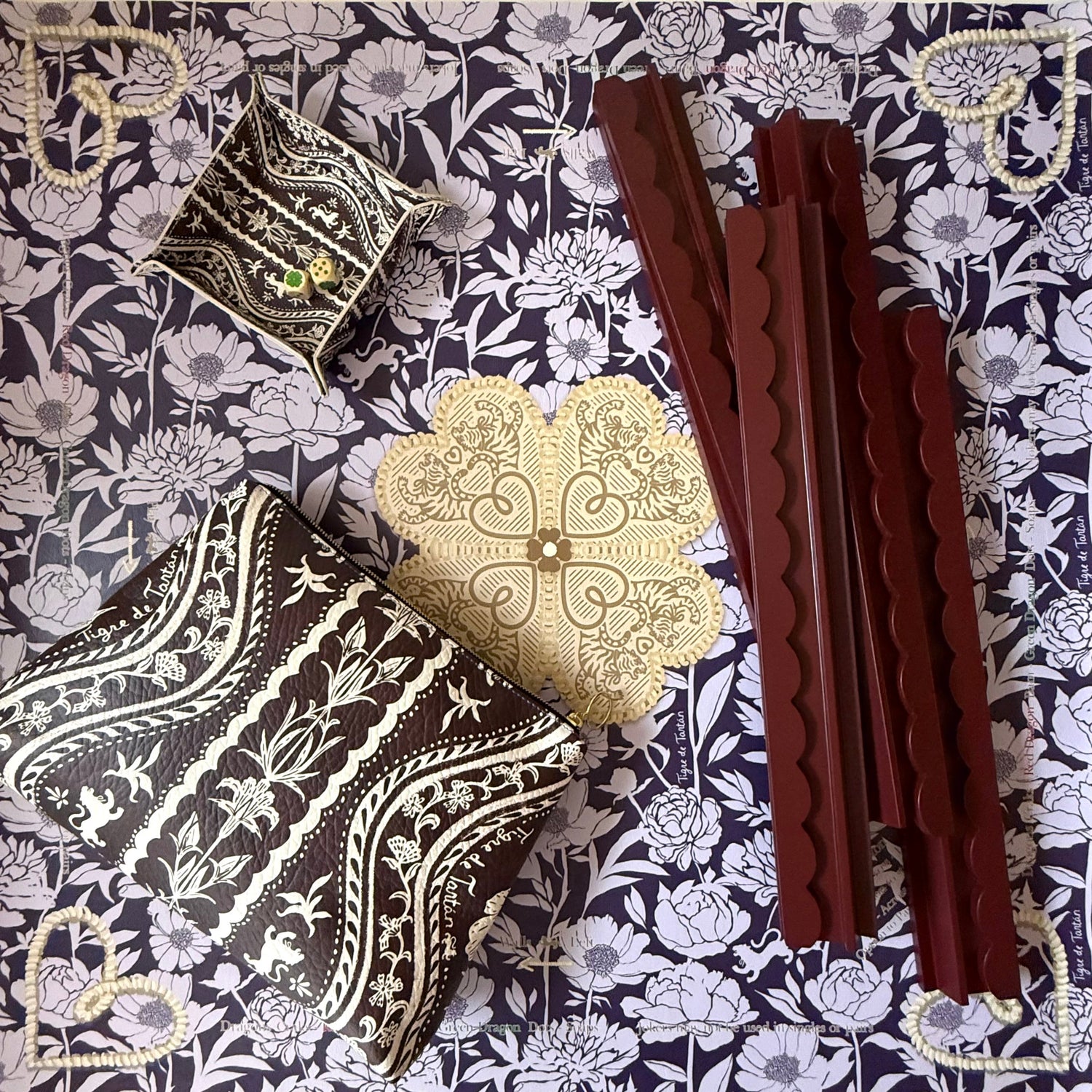
The category's usual answer is a logo on a background. Which is a shame, because 31.5 inches square is — measure it against your walls — the size of a serious print, closer to wallpaper or a scarf than to anything you'd call equipment.
A dining room already has a design language. A mat joins that conversation whether it wants to or not; the only choice is whether it joins well.
We treat the mat as a functional print. Original artwork, carried edge to edge, hand-illustrated by independent female artists — among them Luisa Rangel de Alba of Fait à Main, a Goyard alum — then printed into the grain so the surface reads as art rather than merchandise.
The PLAYFINISH page makes the technical case; the dictionary makes the aesthetic one.
Everything on a table is part of the table; that's the whole idea of a tablescape. We simply think the largest printed surface in the room should be beautiful on purpose. It's an unlikely canvas, which is exactly what makes it interesting.

The practical checklist
The unglamorous five. Run them before you buy anything — ours included.
01
Rolls, never folds
Creases are forever. A mat that arrives rolled can lie flat on night one; a folded one carries its shipping scars into every game after.
02
Backing that grips
The mat should stay where the host put it. Look for a textured underside; smooth backing skates on polished wood, usually mid-charleston.
03
Wipeable vs washable
Know which one you're buying. Wipeable means a damp cloth and no ceremony. Washable means a sink, a drip-dry, and a mat out of commission for a day.
04
Check the storage
A mat lives most of its life rolled up in a closet, so ask how it gets there. A dust bag or tube keeps it clean between Thursdays — oversized rounds often ship without one, in which case a cardboard tube and a high shelf will do. Roll, don't fold, and keep it out of direct sun.
05
Measure the table
Card table, dining table, the kitchen round — measure the surface, not your memory of it. Thirty-one and a half inches fits most tables. It does not fit all of them.
And know the exit before you need one. Ours is a 30-day refund to your original payment method, or 60 days for store credit or an exchange, with a prepaid return label — because a mat you haven't played on yet is still a hypothesis. (Monogrammed and made-to-order pieces are the exception; personalization is permanent on our end too.)
What we'd actually buy first
New to the game? Buy the mat that teaches it. A rules edition prints the American game's dealing order and charleston choreography directly onto the playing surface, so the etiquette sits under your hands while you learn it and the table stops being quizzed.
![Mahjong Mat, Cannage Blonde [W/ RULES]](https://cdn.shopify.com/s/files/1/0567/2566/7876/files/1C78BA9D-E749-4A92-857B-9ED406E25BE4.jpg?v=1781194324&width=1400)
What we’d actually buy first
Mahjong Mat, Cannage Blonde [W/ RULES]
A blonde cane weave that reads as a neutral, with the game's setup reminders printed right onto the playing surface — so a first-timer glances down instead of asking the table. Built on PLAYFINISH™: waterproof, wipeable, sound-dampening.
$175.00 USD
Shop mahjong matsThe Clovers Rules Edition is its greener sister. (We teach the game itself in How to Play American Mahjong.)
Already fluent? Buy the design you want to live with. Caned Trompe L'oeil Natural is the quiet one: a caning pattern that behaves like a neutral and rewards a second look. The Strawberry mat is the opposite — charming, wildly so, and unapologetic about it.
And if you're buying for someone else, buy the rules edition; it's the rare gift that arrives with its own instructions and its own occasion.
One answer per player. The full collection lives here.
Frequently asked
What size is a standard American mahjong mat?
About 31.5 inches (80cm) square. That fits a standard card table and gives four players room for racks, the wall, and discards. Round tables can take a 39-inch round mat.
Are mahjong mats washable?
It depends on the material. Wool and felt should be spot-cleaned. Neoprene usually tolerates gentle washing. Faux leather isn't washed at all — it wipes clean with a damp cloth, which is most of the point.
Do you need a mat to play mahjong?
Honestly, no. People play on bare tables every night. But a mat quiets the tiles, protects the table, keeps racks and walls where you put them, and gives the game a defined center. The table will thank you. So will whoever is downstairs.
What is a rules edition mat?
A playing mat with the American game's core procedures printed right on the surface: dealing order, charleston sequence, and the like. It teaches while you play, and it saves the new player from asking the table for the fourth time.
Buy the mat you'd leave out on the table on purpose. Everything else is specifications.