

Choosing Racks
The short answer
- Buy four at once. Matching racks read as intention; mismatched racks read as leftovers.
- Nineteen to twenty inches, and check the channel. The wall is nineteen tiles long. A rack shorter than the wall deals it in installments.
- Spend where the pusher is. It is the part that fails, and a beautiful tray with a bad arm is a shelf.
- Colour is a tablescape decision, not an equipment one. Picture it in lamplight, because that is where it lives.
Nobody chooses their first racks. They arrive with the tiles — clear plastic, slightly scuffed, the colour of old ice — and because they came free, nobody complains about them out loud.
They wobble. They scratch. The pushers wander off in the night.
And still we keep them, because racks are infrastructure — the beige, unnoticed plumbing of the mahjong table — and nobody thinks about infrastructure until it fails at nine forty-five on a Thursday, mid-wall, with company over.
The second set of racks is the first one anyone chooses.
This guide is for that purchase. Below: what a rack actually is, how it should look on your table, what separates a good one from a cheap one, and the small plastic arm that decides whether your wall survives the push.
A disclosure before we start, because it's short: we make mahjong racks. Mats, too.
So take the tests seriously and our name casually. Every check below works on anyone's racks, including ours. We built ours to pass them.
What a rack actually is
Two parts. The tray holds your hand — thirteen tiles, fourteen on the draw, fanned where only you can see them. The pusher, the L-shaped arm riding the tray's left end, advances the wall toward the table's centre when it's your turn to deal.
One part displays. The other deals.
19–20″
Standard rack length
19
Tiles in a wall
4 lb
Weight of a full wall
4
Racks, bought together
Both parts live in your hands all evening. The buying criteria live there too.
The tray is a shallow runway, and it turns thirteen loose tiles into something you can read at a glance, rearrange one-handed between turns, and defend from your neighbour's cheerful peripheral vision. Furniture for tiles.

Racks are an American invention, worth knowing. The first ones were wood and tin, sold beside the sets of the 1920s craze; catalin followed in the thirties, acrylic in the decades after.
The Chinese game has never used them. The American game is unplayable without them.
This guide assumes the American table.
How they look on the table
Start here, because nobody does.
A mahjong table is four racks and a mat. That's the whole composition. The racks are the largest objects on it after the mat itself, four long bars of colour framing the play space the way a frame holds a print.
Which means the rack is a tablescape decision first. An equipment decision second.

Priorities, then. Colour first, hardware second.
Clear and smoke are the quiet ones. They disappear. They let the mat do the talking.
Deep colours ground the table. A rack in navy or oxblood reads as a decision. Glitter reads as a decision too, of a different school, and we respect it.
Whatever you choose, picture it in lamplight. That's where it will live. Mahjong is an evening game, and evening light warms everything it touches: clear acrylic goes honey, pale colours go richer, dark colours go nearly black.
The camera keeps score. These four bars of colour will sit in the background of every photograph taken at your table for the next decade — every birthday, every Tuesday, every championship wall — long after you've stopped noticing them yourself.
Choose accordingly. The rule is the wallpaper rule: it should look chosen.
Fit: the short version
Fit is binary, so we'll be brief.
The standard American rack runs about nineteen to twenty inches long, sized to the standard American tile. That number is not a suggestion.
The channel — the groove your tiles stand in — has to match your tiles' thickness. Too narrow, and your carefully built thirteen slide sideways like a deck of cards on a boat. Too wide, and every reach for the wall becomes a small percussion performance.

The wall you're pushing is nineteen tiles long. A full-size rack and pusher cover it.
Travel racks and many vintage racks don't. That's how walls get dealt in two nervous installments.
Measure your tiles before you measure the rack. Then measure your game bag. Twenty inches is longer than it sounds.
And check the table itself: four racks, a wall, and four rows of discards ask a great deal of a card table — which is the entire argument for the 31.5-inch mat, made at length in our guide to choosing a mahjong mat.
Material: the honest taxonomy
Three materials cover nearly every rack you'll meet. Each has a decade it belongs to, and each is still being made, found, or inherited today.
The trade-offs are real. So is the spread between good and bad. It runs wider in racks than in almost anything else on the table.
Acrylic. The modern standard, and the sensible one. Light, wipeable, and available in every colour from clear to glitter.
Here is the part the listings skip: you get what you pay for, and with acrylic you can see exactly what you didn't pay for. Good acrylic is heavy-gauge, with polished edges and no moulding seams anywhere your fingers go. It stays clear for years.
Cheap acrylic is a different object wearing the same photo. It will ship. It will rack tiles.
It will also flex at the first push, cloud by the second month, fade by the third — and some cheaply dyed acrylics will leave their colour on your mat or your tablecloth, a parting gift you didn't order.
The photos won't tell you. The price already did.
The marketplaces are full of it, and you already know the names: the same racks, the same five colours, the same stock photography, at a price that answers every question this guide asks.
Wood. The warm choice, and the quiet one.
A wooden rack sits still. It muffles the tile. It matches the furniture in a way plastic never will.
A well-made wooden rack has a gravity to it: it stays where the evening put it, and it makes the whole table feel less like a game night and more like a room that happens to play mahjong.
The trade-offs are honest ones. It's heavier to carry. It can warp somewhere damp. It wipes less happily than acrylic.
For a game that stays home, wood is lovely.
Vintage catalin. The collector's choice — butterscotch and marbled amber from the 1930s and 40s, when American mahjong was new and everything was beautiful on purpose.
Eighty years later, the patina is the price. The plastic is brittle. The pushers are often replacements.
Matching sets of four are genuinely scarce, and priced accordingly. Buy it for joy. Play it gently.
Good acrylic |
Wood |
Vintage catalin |
|
|---|---|---|---|
| Weight in hand | Light | Medium | Medium-heavy |
| Sound | Bright | Muffled | Warm clatter |
| Durability | Years, if heavy-gauge | Can warp | Brittle with age |
| Wipeability | Excellent | Fair | Handle with care |
| Aging | Stays clear | Mellows | Patinas beautifully |
None of these will lose you a game. One of them will match your table.
The pusher: the part that actually fails
Here is the criterion no listing mentions, and the one that matters most.
The pusher's whole job is to stay attached and stay flat while moving a two-tiered wall of tiles across the table. Cheap pushers do neither.
They ride up the wall. They skip. And at the worst possible moment — mid-push, every eye on the tiles — they pop off entirely.
Nineteen tiles, scattered like startled birds. Someone's joker, suddenly public.
Consider what the pusher is up against. A full wall is nineteen stacks of two, close to four pounds of tile, pushed from one end by an arm the width of your thumb, while the player pushing it is mid-conversation and holding a wine glass. The engineering margin is thinner than it looks.
Respect the arm.
Watch a table of experienced players and you'll see the whole ballet: left hand on the rack, right hand on the pusher, the wall sliding forward in one even motion, nobody looking down, nobody breaking the conversation. That's the standard.
Detachable pushers are worth having. They make the racks packable.
But detachable should mean detachable on purpose, with a positive click. Not detachable by ambush.
Weight and feet: the quiet criteria
A rack that skates is a rack that spills. Weight helps, and so do feet: rubber pads or felt dots on the underside, gripping whatever surface the night provides.
The gold standard is simple. A rack you can bump with your elbow without consequence.

Felt is quieter. Rubber grips harder.
Either beats bare plastic. Bare plastic skates at the first enthusiastic push, and it takes your wall with it.
The racks spend the whole night being touched — leaned on, nudged, slid forward and back through four walls and a charleston — so stability isn't a feature on a list. It's the whole personality. Quiet furniture.
On a smooth, wipeable playing surface this matters more, not less. We say this lovingly, as people who make a smooth, wipeable playing surface.
Buying online: reading a rack listing
You'll buy your racks from a website, so learn to read one. Numbers, not adjectives.
A serious listing gives you numbers. Length. Channel width. Gauge or weight.
Weight is a rack confessing its density: heavier acrylic is thicker acrylic, and thicker acrylic is the kind that doesn't flex.
The material should have a name. "Acrylic" is a material; "plastic" is a hedge.
Study the photos like a prosecutor. You want the underside (feet or bare?), the pusher's attachment point (a click mechanism you can see?), and the channel in close-up (seams or none?). A listing with five angles of the colour and none of the join is telling you what it's proud of.
Read the reviews sideways. Ignore the stars. Search the text for flex, wobble, clouded and stain — the four horsemen of the cheap rack — and count how often they appear in reviews dated six months after purchase.
Then read the return policy. It is the only hand test you get: racks arrive, you press the ends, you push a row of books across the table, you wipe a coloured rack with a white cloth, and if any of it fails, the racks go back.
Ours runs thirty days, prepaid label in the box, no interrogation. That's the fitting room. Use it.

The practical checklist
The unglamorous six. Run them on arrival day, while the return window is open.
01
Buy four at once
Matching racks read as intention; mismatched racks read as leftovers. Four racks, four pushers, bought together rather than assembled over years.
02
Press the ends
No flex. No seams in the channel. No rough spots where your fingers go.
03
Test the pusher
Attach it and lift gently by the arm; it should stay on. Then push a row of books and watch whether the arm glides flat or climbs. A pusher that climbs will climb every night you own it.
04
Check the dye
White cloth, firm wipe, coloured rack. The cloth should stay white.
05
Bump the rack
With your elbow, gently. It should hold its ground.
06
Measure your storage
Twenty inches fits a game bag designed for it, and almost nothing else. Check the bag. Check the drawer.
What we'd actually buy first
One confident path, then the exceptions.
A heavy-gauge acrylic set of four: polished edges, seamless channels, pushers that click home and stay there. In clear, in smoke, or in one colour you love enough to see every week for a decade.
That set plays well. It wipes clean. It travels without ceremony. It asks nothing of you.

What we’d actually buy first
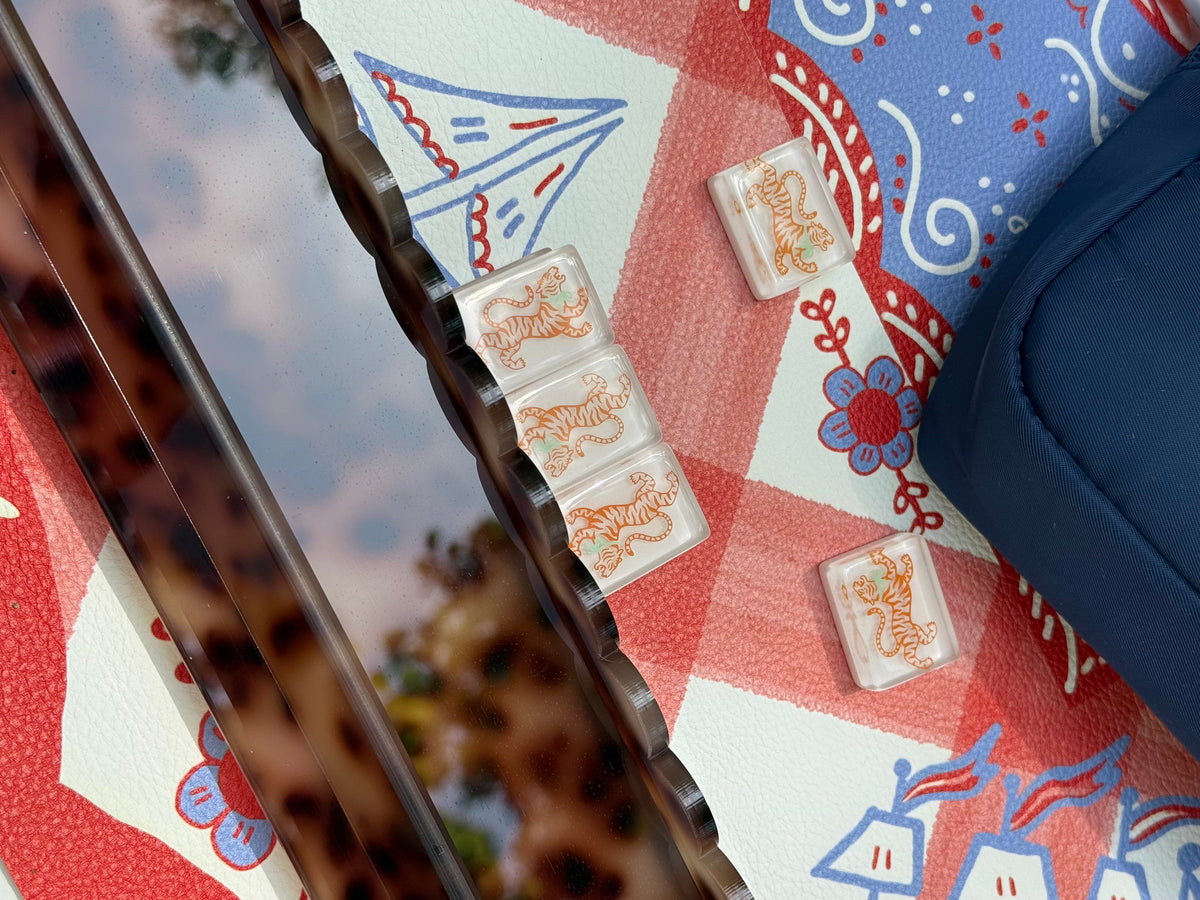
Tortoise Scalloped Acrylic Mahjong Racks, set of 4
Heavy-gauge acrylic, polished edges, four magnetic pushers that click home and stay there, and a custom dust bag so the set travels the way it plays. Built to every standard in this guide, which is the only endorsement we'll make of it.
$175.00 USD
Shop mahjong racksSpend where the pusher is, if you have to choose. A beautiful tray with a bad arm is a shelf.
Cheap racks bill you later: in clouding, in fading, in a ring of dye on a mat you love.
Well-made racks earn their money invisibly: in the push that doesn't strain a wrist, in the clear that stays clear through years of shuffling hands, in the colour that's still itself after two years of Thursdays and looks, on the five-hundredth night, exactly like the photo that sold you.
That's the purchase.
Our own racks live in the collection, built to every standard in this guide. We'd say more, but the tests above say it better.
The exceptions, earned rather than asserted. Wood, if your game stays home and your room is wood. Vintage catalin, if the patina is the point and you accept the brittleness as its price.
Frequently asked
Do you need racks to play American mahjong?
Effectively, yes. The rack holds your concealed hand, and the pusher is how the wall gets dealt. The Chinese game manages without racks entirely, which tells you something about both.
How long is a standard mahjong rack?
About nineteen to twenty inches, sized for standard American tiles. Vintage and travel racks run shorter; check the channel against your tiles either way. Remember the wall: nineteen tiles long, and a rack shorter than the wall deals it in installments.
Is there really a difference between cheap and expensive racks?
Yes, and it is visible on a schedule. Cheap acrylic flexes immediately, clouds within months, and fades within a season; dyed cheaply, it can stain whatever it sits on. Expensive acrylic mostly just sits there being clear, year after year.
What's the difference between a rack and a pusher?
The rack is the tray that holds your hand. The pusher is the arm that slides along it to advance the wall. They are sold together. They fail separately. The pusher fails first.
Are vintage Bakelite and catalin racks worth buying?
For beauty, absolutely — the marbled butterscotch of a 1940s set is gorgeous in a way nothing new manages. For daily play, with caution: the plastic is eighty years old, brittle, and often on its second set of pushers. Buy them as functional antiques, not as equipment.
Will any racks fit my tiles?
Mostly, yes; standard racks fit standard tiles. The exceptions are vintage tiles, which run smaller and thinner, and jumbo tiles, which run thicker. When in doubt, the channel test settles it: tiles should stand upright without leaning or rattling.
Buy the racks that look chosen and act invisible.
Everything else is hardware.