

Choosing Tiles
The short answer
- Count 152 plus blanks. A 144-tile Chinese set has no jokers and cannot play the American card.
- Standard is about 1.3 inches tall. It matches your racks, your wall and a 31.5-inch mat. Jumbo is a real kindness if your table plays in lamplight.
- One material all the way through. Layered tiles delaminate; the failure starts at the corner and does not stop.
- Ask who drew the faces. Traditional designs are a commons. Artist sets name their artist in the first paragraph.
Nobody remembers their first racks. Everybody remembers their first tiles.
Ask a player about their first set and you'll get a story. Ask about their first racks and you'll get a shrug.
The weight of them, cool and dense in the palm; the clack when the wall comes down; the small carved bird on the one-bam that somebody at the table always has a theory about, because the one-bam is never just a bird, it's a committee.
Tiles are the part of mahjong you touch — every turn, every night, thousands of times a year — and they're the purchase that decides how the game feels in the hand. This is the longest relationship at the table. Act accordingly.
So they're worth choosing slowly. Below: the count, the size, the material, and the details where quality hides.
The usual disclosure, briefly, because it shapes what follows: we make mahjong mats, and we ship tiles, too — in a bag, on purpose, for reasons we'll defend below. The advice stays honest anyway.
Count first: the 152 answer
Before size, before material, before the butterscotch daydreams: count.
152
Tiles, American set
8
Jokers
1.3″
Standard tile height
144
Chinese set — no jokers
An American set runs 152 tiles plus blanks. The arithmetic, for the record: 108 suited tiles across dots, bams, and craks, then 16 winds, 12 dragons, 8 flowers and seasons, and 8 jokers. The suits run one through nine, four of each — dots are circles, bams are bamboo, craks are characters — and learning to tell a three-bam from a four-bam at arm's length is the small daily miracle of every new player's first month.
Those jokers are the whole ballgame. American mah jongg builds its hands around them, rotates them through the charleston, and slaps them down in exposures with a satisfaction that borders on theatrical.
And they are the first thing a set loses.
Blanks are the insurance policy: when a tile walks off — and one always eventually walks off — a blank becomes its replacement.

Chinese sets run 144, with no jokers at all. Beautiful, legitimate, and a different game.
If you play the American card, a 144-tile set is not a bargain. It's a different sport.
Buying used? Count before you pay. Mismatched backs mean a married set: tiles from two households, joined in haste, forever slightly wrong.
Size: the standard and the jumbo
Standard American tiles stand about 1.3 inches tall, and that number connects to everything else on the table. Your racks are sized for it. Your wall is nineteen of them long, and at standard size it lands precisely where the mat leaves room for it.
The full geometry lives in our guide to choosing a mahjong mat.
Jumbo sets run bigger, and they're a genuine kindness: easier to read across the table, easier on aging eyes, easier for fingers with opinions about arthritis. For a group that plays in lamplight after dinner — which is to say, nearly every mahjong group that has ever existed — jumbo tiles are the difference between reading the table and leaning over it.
The trade is shuffle room. A hundred and fifty-two jumbo tiles being washed on a card table is a contact sport — elbows in, tiles sailing, the two players on the short ends quietly doing whatever it takes.
Measure first.
Vintage and travel tiles run smaller. Charming, fiddly, and occasionally so petite the whole set looks carved for a very elegant doll.
If you're buying vintage to match existing racks, bring a rack with you. Sizing drifted over the decades.
Then there's weight, which is a size all its own. A dense tile sits in the hand like it means it.
Pick up one tile from any set you're considering — or, since this purchase will almost certainly happen online, from the box the day it arrives. The hand test hasn't moved. Only the venue has.
If it feels like a souvenir, it is.
Material: the honest taxonomy
Four materials, each with its decade. The trade-offs are real, and none is fatal.
Modern resin. Melamine and its cousins: the standard for good reason. Dense, cool, bright-sounding, and consistent from tile one to tile 152.
Quality still spreads wide: the tells are weight, engraving depth, and paint that stays inside its lines. Cheap white resin also yellows, slowly and then unmistakably. Good resin shrugs off spills, wipes clean, and will outlive us all.
The honest sentence, then: you get what you pay for.
Good resin is one material all the way through. The color is the tile, not a coating on it. A chipped corner just reveals more of the same.
Cheaper sets are built in layers: a thin printed face pressed over a base of something less noble. The failure has a name, delamination, and any player forum is a museum of it.
Wood. The soft-spoken option. Wooden tiles — vintage sets especially, plus some modern artisan work — are light, warm under the hand, and gentle on the ears, with a knock muffled almost to nothing.
They don't clack. Some tables consider that a mercy.
The trade-offs are honest ones. Wood warps in damp houses, dents when dropped, and wears its painted faces faster than engraved resin. Vintage wooden sets are charming, affordable, and best treated as the paperback editions: read them happily, shelve them gently.
Vintage catalin and Bakelite. The American classics of the 1930s and 40s: butterscotch, apple juice, marbled amber, often hand-carved.
They have a warmth no modern tile imitates, and it isn't sentiment: catalin genuinely holds heat differently. And the market agrees, to judge by the price tag.
Buy for beauty. Inspect for cracks, chalky paint, and the married-set shuffle described above.
Bone and bamboo. The originals: carved bone faces dovetailed onto bamboo backs, mostly Chinese export work from the 1920s and earlier. The faces are often hand-painted, and the best of them are tiny paintings.
The knock they make is softer and older than anything else in this guide. They're also the most delicate: the dovetail joints loosen with a century of shuffling, the tiles run small, and there are no corner indices to help you.
They ask something of you, too. Care in the shuffle. Patience with the craks. A cheat sheet for the new player who doesn't read characters.
 Modern resin
|
 Wood
|
 Vintage catalin
|
 Bone & bamboo
|
|
|---|---|---|---|---|
| Feel in hand | Dense, cool | Light, warm | Warm, light | Light, organic |
| Sound | Bright clack | Muted knock | Warm clatter | Soft knock |
| Engraving | Uniform, deep | Carved or printed | Hand-cut, varied | Carved, painterly |
| Durability | Excellent | Dents, warps | Brittle with age | Joints loosen |
| Corner indices | Yes | Rarely | Usually | No |
None of these will lose you a game. One of them will feel like yours.
Where quality shows
Tiles are judged at an inch and a half. Get close.
Quality rarely fails in one dramatic way. It fails in about ten small ones, and nearly all of them are visible before you pay — in a listing photograph, or in the first ten seconds out of the box. The inventory, roughly in the order you'll meet it.
Shallow engraving. Deep-carved tiles hold their paint for decades and read clearly in bad light. Shallow-stamped ones fade into smooth plastic with a biography of better days. Run a fingernail across a face; you'll know.
Paint that wanders. Crisp fill stays inside the stroke the carver cut. Cheap fill spills past it, and the spill is permanent.
Colour bleed. Black crossing into red on a character, or red pooling where the white should be. One colour printed over another is a registration failure, and it means nobody looked before it shipped.
Layered construction. A thin printed face pressed over a base of something less noble — often a different colour entirely, which is exactly how you catch it. A chipped corner that shows green under white is a chip through a veneer. Good resin is one material all the way down, and a chip just reveals more of the same.
The failure has a name, delamination. It starts where the thumbnail lands. It doesn't stop, and there is no repair.
The tile was the layers, and the layers have filed for divorce.
You don't have to take our word for how ordinary this is. Search for mahjong tile delamination and you'll find your way into a small self-help literature: Facebook groups and TikToks comparing epoxies and superglues, players workshopping which adhesive holds a face down longest and for how long. It is a genre. Genres only form around common problems.
Yellowing. Cheap white resin ambers with age, slowly and then unmistakably, and it does it unevenly — so a set doesn't age into a warm ivory, it ages into two shades of itself.
Seams and flash. Moulding ridges along an edge, exactly where your fingers close on the tile a few thousand times a night. Good tiles are finished after they're cast. Cheap ones are cast and sold.
Mismatched backs. Dealers photograph faces because faces sell sets. The wall shows its backs to the table all night. Look for one colour, one depth, one family — a married set announces itself from behind.

Tiles that won't sit level. Inconsistent dimensions inside one set. They rack unevenly, they lean, and the wall you build has a slouch in it.
A tile that feels like a souvenir. Density is the tell you can't photograph. Pick one up. If it feels like a keychain, the rest of the set will too.
A count that doesn't add up. 144 sold as 152. Seven jokers where there should be eight. No blanks at all. The listing that won't state a number is stating something.
Then the indices: the small numbers and letters in the corner that tell you what you're holding without decoding the characters. New players should want them, loudly and without apology. Veterans pretend not to need them and use them anyway.
And the jokers. Modern jokers arrive in full plumage — glitter, confetti, entire tiny scenes. Vintage sets often have none, because jokers became essential later, and sourcing eight that match a 1940s set is its own quiet hobby.
There is a whole resale economy in orphaned jokers, exactly as dignified as it sounds. Ask before you fall in love.
Modern uniformity is its own virtue: a factory set has no telltale tile, no face you recognise from across the wall. Vintage variation means you start to know individual tiles, which is either charming or a tell, depending on how seriously your table plays.
On hand-carved sets, no two flowers match exactly. That is not a defect. It's provenance you can hold.
Design: whose bird is it
One more thing a listing won't tell you. Who drew the faces.
Traditional tile design is a commons. The crane on the one-bam, the plum and orchid among the flowers, the dragons in their established colors: nobody owns these, and every maker's version is legitimate, the way any publisher may print the sonnets.
Then there are artist sets, and they are having a moment.
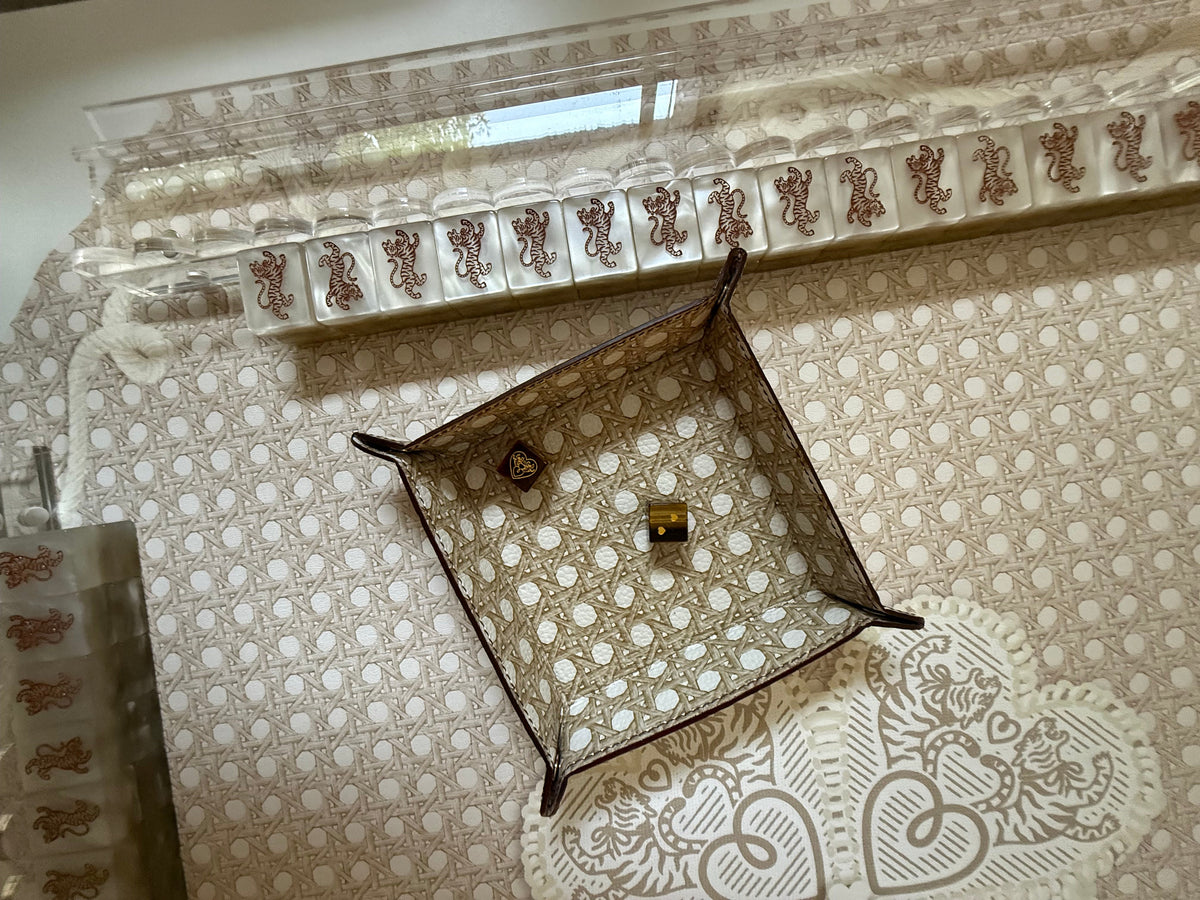
A working illustrator reimagines the whole menagerie. The flowers become a garden that actually exists, the jokers become tiny portraits, the one-bam becomes a bird with a name and a following, and the whole set reads as one person's hand rather than a factory's habit.
That hand is the product. It's priced like the work it is.
So when you find that same design, the same garden, the same bird, selling elsewhere for half the price, it isn't a deal. It might be theft.
Copying a small artist's tile faces is cheap to do and nearly impossible to police, and the trade in copies runs on buyers who never learn there was an original, until the day the artist posts the side-by-side and the whole table finds out.
It happens. The artist gets nothing. The buyer gets the art without the artist. Usually pressed onto the layered construction described above.
The check takes ten seconds. Artist sets name their artist, loudly, in the listing's first paragraph.
A familiar design with no name attached is a question. Ask it.
Buy the original. The bird deserves it, and so does the person who drew it.
We commission hand-illustrated work from independent artists ourselves. This one is personal.
The faces, and the ones that aren't
Traditional faces are not merely traditional. They're a shared language.
Three suits, four winds, three dragons, a bird on the one-bam. A player who learned in 1974 can sit down at a table tonight and read every tile without asking a question. That fluency is the accumulated value of a century of not changing much.
Then there are the sets that change a great deal. Translucent tiles, iridescent faces, whole suits redrawn as something else entirely — a garden, a menagerie, a joke that runs the length of the set.
They are beautiful. Some of them are ours.
They also cost something, and what they cost is fluency.
A restyled six-dot is still a six-dot, but for the first few nights it is a puzzle wearing a costume. And the person who pays that cost isn't you — you chose the set, you know its jokes. It's the newest player at the table, who is already decoding a card she has never seen and now has to decode the tiles too.
This is what the corner indices are for. On a traditional set they're a courtesy. On a heavily restyled one they're the thing that makes the set playable by a guest.

Traditional faces
A century of not changing much.

Restyled faces
Character bought with fluency.
So: buy the restyled set if it's your second or your fifth, and buy it with indices if your table teaches. Buy traditional faces if the set is a gift for a beginner, or if the table runs mixed and you would rather the game moved.
We sell both. We would rather say this than sell you the wrong one.
Sound: the music criterion
A mahjong night has a soundtrack, and the tiles are the instruments. Dense melamine clacks: bright, crisp, unmistakable.
Catalin clatters, a half-step warmer. Wood barely knocks. Bone and bamboo knock softly, like a door closing somewhere else in the house.
The shuffle alone — that great wash of a hundred and fifty-two tiles being mixed face-down at the start of every game — is thirty seconds of percussion that sets the tone for everything after. It's the overture.
You'll hear that sound a few thousand times a night. So will the table. So will whoever's watching a film in the next room.
This is, since we're being honest, where our interest in surfaces appears. A dense, sound-dampening mat takes the edge off all four materials without deadening the music. We make one; it's called PLAYFINISH™, and the mat guide covers the acoustics properly.
Buying online: the listing, the box, and the bag
Almost nobody buys tiles in person anymore. The set you're considering is a grid of photographs on a website, which changes what inspection means.
It doesn't abolish it.
Read the listing like a prosecutor. Dimensions in numbers, not adjectives: "standard" is a vibe, 1.3 inches is a fact.
Weight, if they give it, is a density confession. The count stated outright: 152, eight jokers, blanks included; silence on any of these is also an answer.
Favor customer photos over studio renders, because customers shoot in the light you actually live in.
Then do the imagining the studio did for you. Product photos are taken in bright, white, honest-to-nobody light; your table is warm lamplight at nine p.m.
Ivory deepens. Brights saturate. Glitter either sings or commits crimes.
Now the box. The box deserves its own paragraph.
The printed boxes on those websites, ribboned and foil-stamped and photographed like perfume, are packaging designed to photograph rather than travel. Mail is unkind to them.
Corners crush, seams split, lids arrive pre-dented — and spend five minutes on mahjong Instagram and you'll find the entire genre: the crushed corners, the split seams, the box that gave up somewhere over Ohio, documented in portrait mode by disappointed players.
And even an intact box was never storage. It scuffs on the shelf, sheds at the corners, warps the first time something damp shares the closet with it, and slowly becomes the saddest object in the house.
Which is why our tiles ship in a bag, on purpose. A strong bag survives the mail without ceremony, then becomes the storage: zips shut, carries to game night, fits in the tote beside the wine.
It doesn't photograph like a jewel box. It behaves like one.
Finally, the return policy, which is the online version of the hand test. Ours is thirty days with a prepaid label: the tile comes to your table, your lamp, your hands, and the inspection happens where the playing will.
That's the fitting room. Use it.
Whatever size you land on, hold the number against the three things it has to live with: your racks' channel, your table's real estate, and the hands of the oldest player at your game, in ascending order of negotiability.
The vintage hunt: resale without regrets
The great sets of the last century are online too, scattered across resale sites and auction listings, photographed on kitchen tables between the toaster and the fern.
Searching them is a skill. It rewards the patient.
Set alerts. Sort by newly listed. Never by best match.
Learn the misspellings (mah jong, majhong, mahjongg), because the bargains hide behind them, posted by sellers clearing a cabinet rather than courting a collector.
Then interrogate the photos like the prosecutor you became a few sections ago.
Ask for the full count, laid out and visible. Ask for the backs.
Ask about smell. Old materials keep their biographies, and a set that lived forty years beside cigarettes will tell you so forever.
Ask about storage, too. A damp basement warps bone and bamboo and clouds catalin.
Give the jokers particular suspicion. They're the first tiles any set loses. Replacing them starts the orphaned-joker hobby described above.
Price against sold listings. Not asking prices.
Asking prices are wishes. Sold prices are weather.
And know what's knowable. The count, the backs, the cracks, the smell. The rest is the fun.
A vintage set arrives carrying eighty years of somebody else's Thursdays, which is either the whole appeal or a reason to buy new.
Both are correct.
The practical checklist
The unglamorous eight. Run them before money moves. Yes, all eight.
01
Count the set
152 plus blanks for American play. Out loud, if you have to. Twice.
02
Check the backs
One color, one depth, one family. Married sets announce themselves from behind.
03
Sample the paint
One tile per family, inspected close. The seven tell you about the 152.
04
Match the rack
Standard tiles fit standard channels; jumbo and vintage each need their own arithmetic.
05
Ask about jokers and blanks
Eight jokers for the American game. Blanks for the decade after that.
06
Ask who drew it
Traditional faces are a commons. Artist designs name their artist.
07
Mind the storage
Bags win, zippers matter, and the closet thanks you.
08
Read the return policy
Thirty days and a prepaid label turns arrival day into the hand test.
What we'd actually buy first
One confident path, then the exceptions.
New to the game? A modern resin set, standard size, deep engraving, eight jokers, four blanks, corner indices worn without shame — a set that plays beautifully on night one, forgives every spill of the learning year, and will still be dealing walls when you're the one teaching the beginner.
Buy once.

What we’d actually buy first
House Hearts, WARM WHITE: Classic American Mahjong Tile Set
Modern resin, standard size, deep engraving, eight jokers, corner indices worn without shame. A set that plays beautifully on night one, forgives every spill of the learning year, and will still be dealing walls when you're the one teaching the beginner.
$275.00 USD
Shop tile setsThe exceptions, earned rather than asserted: vintage catalin if the patina is the point and you'll inspect like a conservator, bone and bamboo if the history is the point and your table can handle tiles without training wheels and your shuffle can stay gentle.
One more honest minute: a set you'll play weekly for twenty years costs less per evening than the wine beside it. Choose like it.
Frequently asked
How many tiles are in an American mahjong set?
152, plus blank replacements: 108 suited tiles, 16 winds, 12 dragons, 8 flowers and seasons, and 8 jokers. Chinese sets run 144 with no jokers.
Can you play American mahjong with a Chinese set?
Not properly. The American game requires eight jokers, and a classical Chinese set has none. You can add loose jokers to fill the gap, but matching them to an older set is harder than it sounds.
What are mahjong tiles made of?
Modern tiles are melamine and similar resins. Mid-century American sets were cast in catalin and Bakelite. The oldest sets pair carved bone faces with bamboo backs.
What size mahjong tiles should I buy?
Standard, about 1.3 inches tall, for most players: it matches racks, walls, and mats. Jumbo for readability. Vintage sizes only if the set itself is the reason.
Do mahjong tiles come with a case?
Most sets ship in a printed box: pretty, photogenic, and roughly as durable as the mail allows. Some, ours included, ship in a bag built to be used. Either way, plan real storage.
Why are the faces on my tiles peeling?
Delamination: the set was built in layers, a printed face pressed over a cheaper base, and the layers are separating. It starts at the corners, and it doesn't stop. One material, all the way through, is worth paying for.
Are vintage mahjong tiles worth buying to play with?
Yes, with inspection. Count them, check the backs, examine the paint, and accept that eighty-year-old plastic plays best gently.
You'll hold the tiles every single turn. Buy the ones your hand looks forward to.
Everything else is the room.